
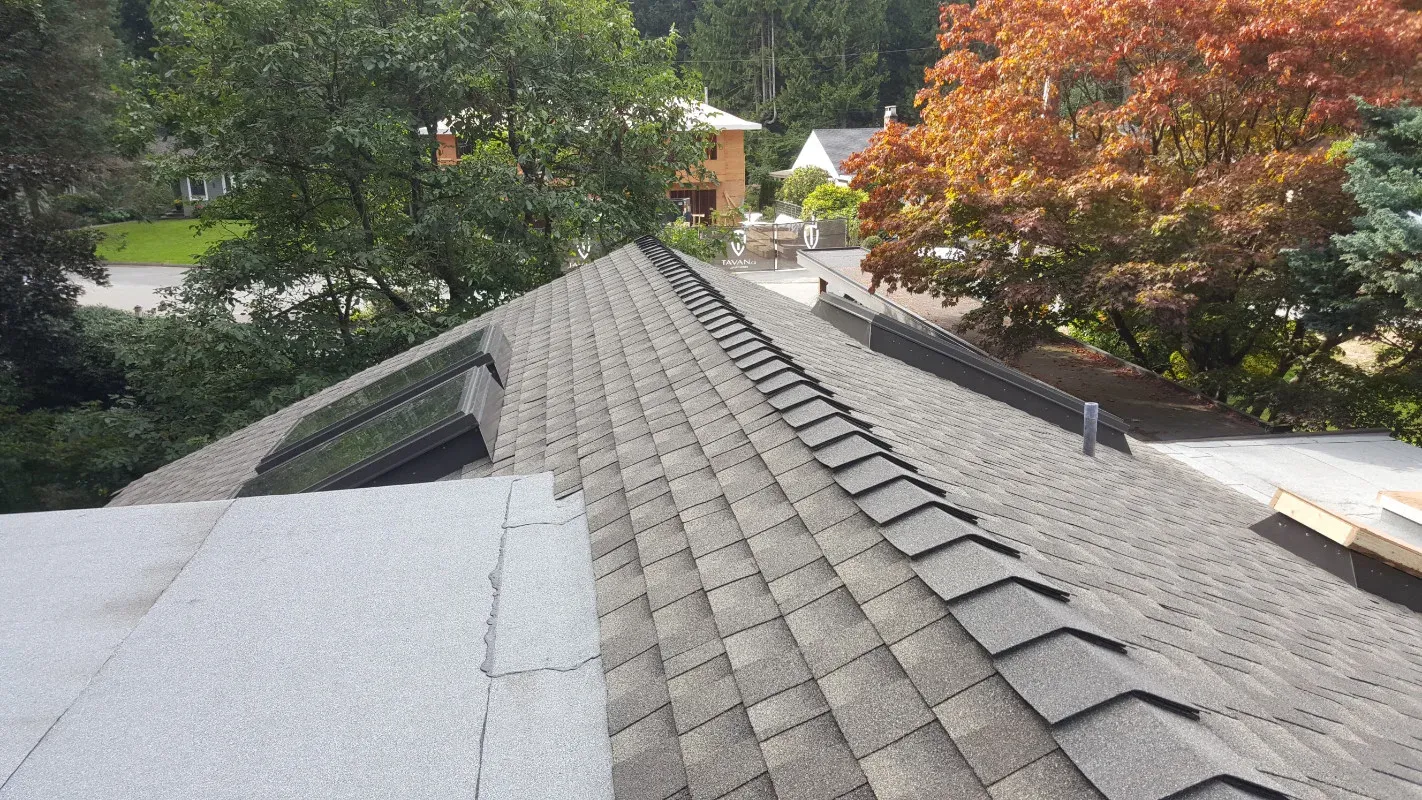
AFTER THE CLEARING
Moss Treatment and Prevention
Treatment slows regrowth on a roof that has already been cleared. Applied in a controlled line, timed to the season, with care taken over what sits below.
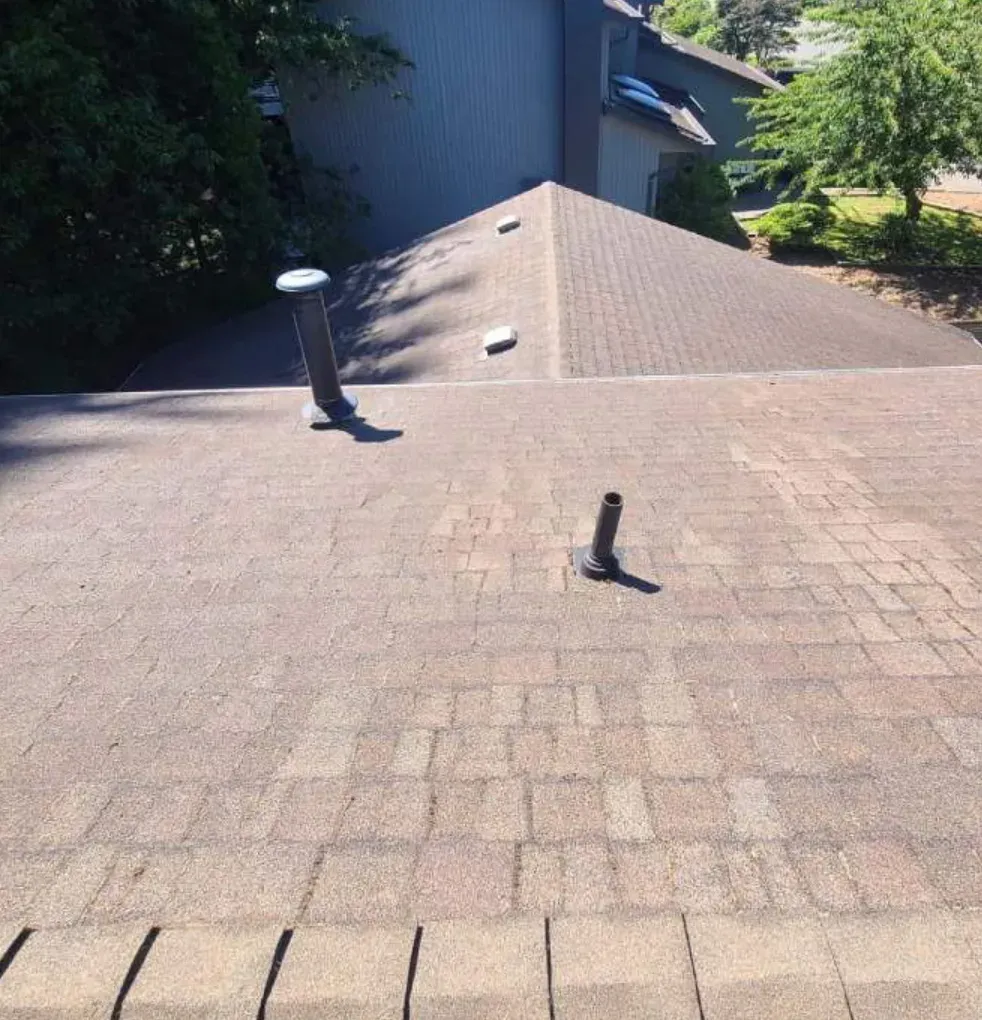
Treatment is the smaller half of this job, and it is the half most often sold as if it were the whole thing. It is worth being plain about what it does.
Once a roof has been cleared, what is left is a surface with no visible growth on it and a lot of spores in the air above it. Treatment works on that. It makes the surface less hospitable for a while, so the next generation takes longer to establish. What it does not do is lift a mat that is already there, and it does not put an end to the cycle. Moss grows here because of shade, damp and eight months of rain, and none of those change.
Order matters more than product
Applied to a roof still carrying growth, treatment soaks into the mat and stops. The mat holds it, the covering underneath never sees it, and a season later you have dead moss holding water instead of live moss holding water. The difference to your roof is close to nothing.
So the sequence is fixed: the growth comes off first, by hand, and treatment goes on afterwards to a surface that is actually exposed. If someone offers to treat a heavily mossed roof without clearing it, they are selling the easy half.
Timing against the wet season
On this part of the Island the rain settles in around October and does not really let up until March. That stretch decides everything about when this work is worth doing.
A dry roof in June or July takes treatment properly and holds it. The same roof in November sheds most of it down the slope and into the gutter within a day. It is not that the product is wrong; it is that the roof is already running with water.
That is also why we would rather book a shaded property in early summer than squeeze it in during the wet. The work is the same either way. The result is not.
Applied along the roof, not sprayed over it
What goes on a roof comes off a roof. Every drop of it eventually reaches the gutter, the downspout, and whatever the downspout discharges onto — which in most of Saanich is a garden bed, a lawn, or a drain that ends up in the same watershed as everyone else’s.
So the application is a controlled line along the courses rather than a broadcast spray across the slope. Plantings under the eaves get covered or wetted down first. We keep it off glass, off decking and off anything with a finish on it. And we will tell you what we used by name, so you can read about it yourself instead of trusting an adjective.
That is the whole environmental position on this site, and it is deliberately made of things we do rather than things we claim.
Prevention that is not a product
Some of what keeps a roof clear has nothing to do with treatment at all.
Light and moving air do more than anything in a container. A limb sitting over the north slope, a hedge grown up to eave height, a neighbouring fir that has closed over the roofline in the fifteen years since anyone looked at it — those are the reasons a slope stays damp, and dealing with them changes the roof more than we can. Where that is the real cause, you will hear it from us, even though the honest answer means less work for us.
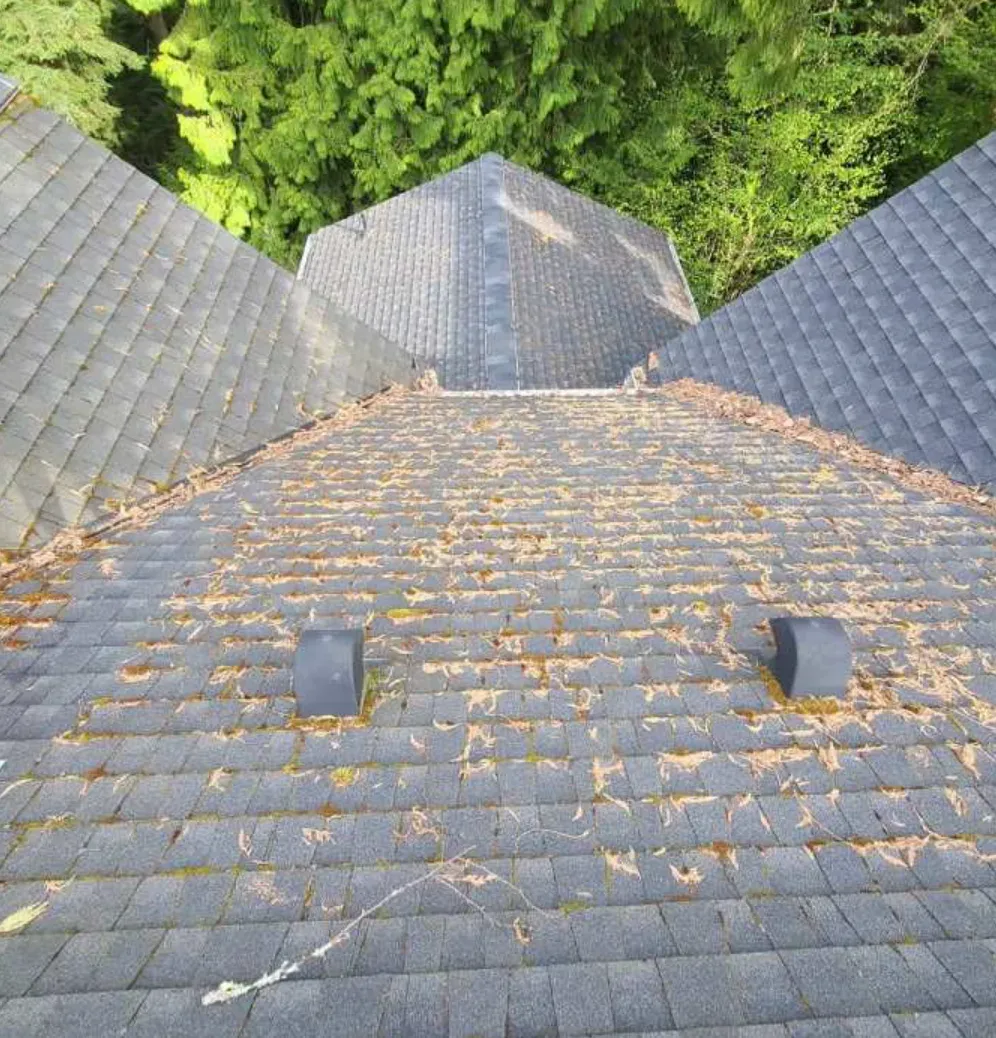
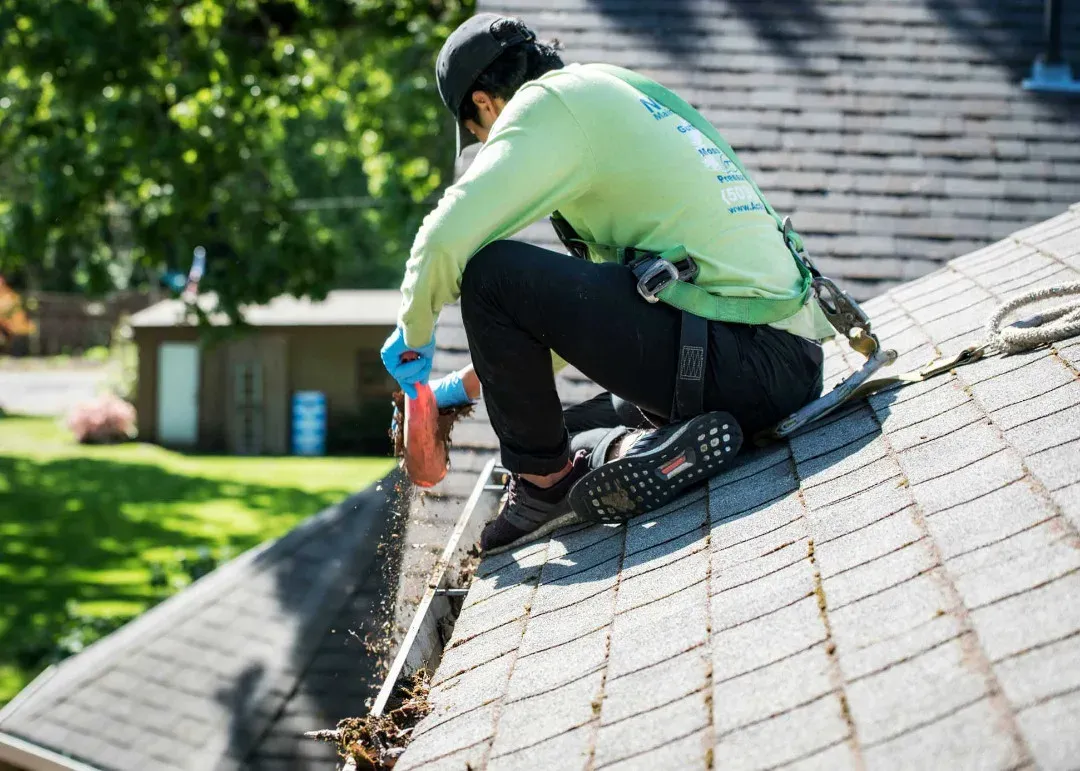
Debris is the other half. Needles and leaves lying on a slope hold moisture exactly where growth wants it, and a roof cleared of loose debris in autumn goes into the wet season in far better shape. On a lot of properties that single habit does more than any treatment.
What a repeat visit looks like
Most shaded Saanich roofs settle into a rhythm of every two to three years. Open ones stretch further. Rather than put you on a schedule, we tell you what we saw and roughly when it will want looking at again, and leave you to call when it suits.
If it turns out the roof has more life in it than you thought and does not need us for a while, we will say that too. Free estimate, nothing attached, Monday to Friday.
The clearing itself is covered under roof moss removal, and if the growth has reached the trough as well, that is gutter moss removal.
How it works
How a Moss Visit Runs
Four steps, and the roof is ours from the moment the ladder goes up. You tell us what you are looking at, we price the roof in front of us, and you hear what we found before we leave.
Tell us what you can see
Your address, the roof covering if you know it, and which slopes have gone green.
A photo from the driveway is worth more than a description. North side, shaded by a big fir, growth thick enough to see from the road — that tells us most of what we need before we arrive.
We price the roof itself
Cedar, asphalt and concrete tile are three different jobs, and the quote reflects which one yours is.
Covering, pitch, height, how far the growth has spread and what stands under the eaves all move the figure. You have it before anything is booked.
The growth comes off carefully
Moss is lifted and brushed off the surface, not driven off with pressure.
We work down the slope so nothing is pushed under the courses, keep the run of water in mind the whole time, and take care around whatever is planted below.
You hear what the roof told us
Standing on a roof shows you things the lawn never will.
A course lifting at the edge, a valley holding damp long after the rest has dried, granules already thin where the growth was heaviest. You get that plainly, with nothing attached to it.
Four steps, and the green is gone.
- You send the address and a photo.
- We send back a price for your roof.
- The growth comes off.
- You know what shape the roof is in.
Send the form or call for a free, no-obligation estimate.
Customer reviews
What customers say
“Great customer service, and they came quickly..will be using again for sure”
“They do a great job and provide great customer service! They are always reliable. Thank you,”
Got questions?
Moss Treatment & Prevention — questions
Does treatment remove moss on its own?
No. Treatment works on what is left after the bulk is gone, and on the spores that have not established yet. Applied to a roof still carrying a thick mat, it soaks into the mat and does very little underneath it. Clearing first, treating second — that order is the whole point.
How long does a treatment last?
On a shaded slope under trees, roughly a season or two before growth is visible again. On an open roof with good sun, longer. We would rather give you that range than a number that sounds better and turns out to be wrong.
Is the treatment safe for the plants under the eaves?
We apply along the roof in a controlled line rather than broadcasting it, and we cover or wet down what is planted below before we start. We will also tell you which products we used, so you can look them up yourself rather than take our word for it.
When should treatment be applied?
Late spring or summer, on a dry roof, after the growth has been cleared. Applying to a wet roof in November means most of it is on the driveway before it has done anything.
Do zinc or copper strips work?
They help on the courses directly below them, and they do very little further down the slope. On a low, simple roof they are worth considering. On a tall or complex roofline they are usually less effective than people expect, and we will say so rather than sell you the strip.
Can you treat without removing the growth first?
We would not recommend paying for it. You end up with dead moss still holding water on the roof, which is most of the problem it was causing while it was alive.
Will trimming my trees help more than treatment?
Often, yes. Light and air moving across a slope do more for a roof than anything we apply to it. Where a limb over the north face is the actual cause, we will say that — even though the honest answer means less work for us.
How often should a Saanich roof be looked at?
Shaded roofs under fir or oak tend to want attention every two to three years. Open roofs go longer. The wet season runs roughly October to March here, and that stretch is what sets the pace.
Moss Treatment & Prevention in Victoria and the surrounding area
Tell us the address and we will get you a price.