
PROTECT THE COVERING
Roof Moss Removal in Saanich
Moss holds water against your roof. We lift it off by hand, work down the slope so nothing packs under the courses, and tell you the condition underneath.
Before and after
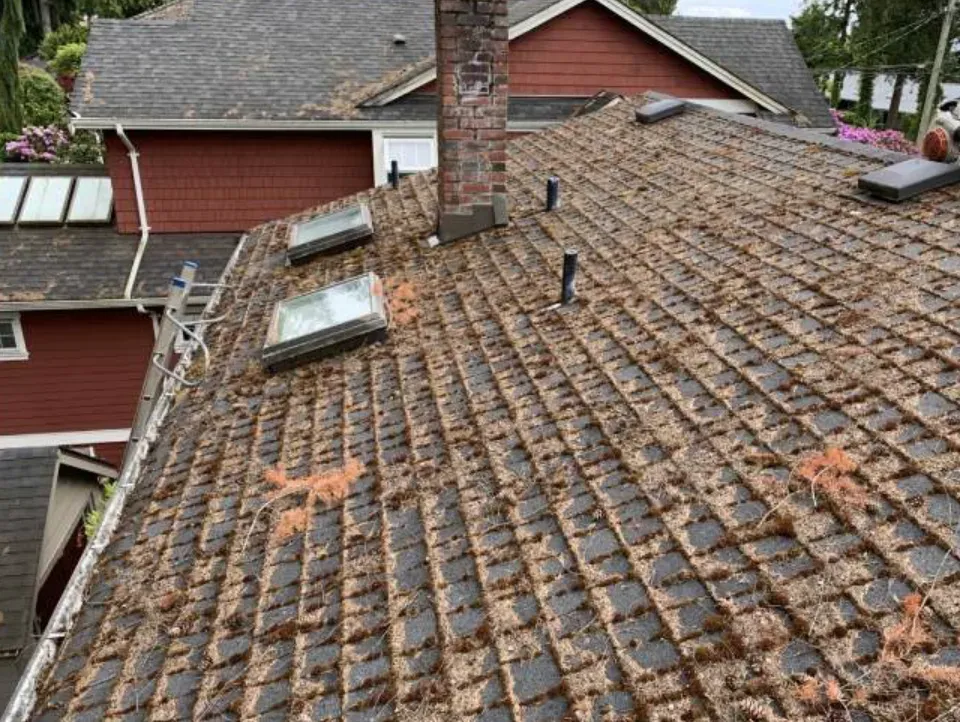
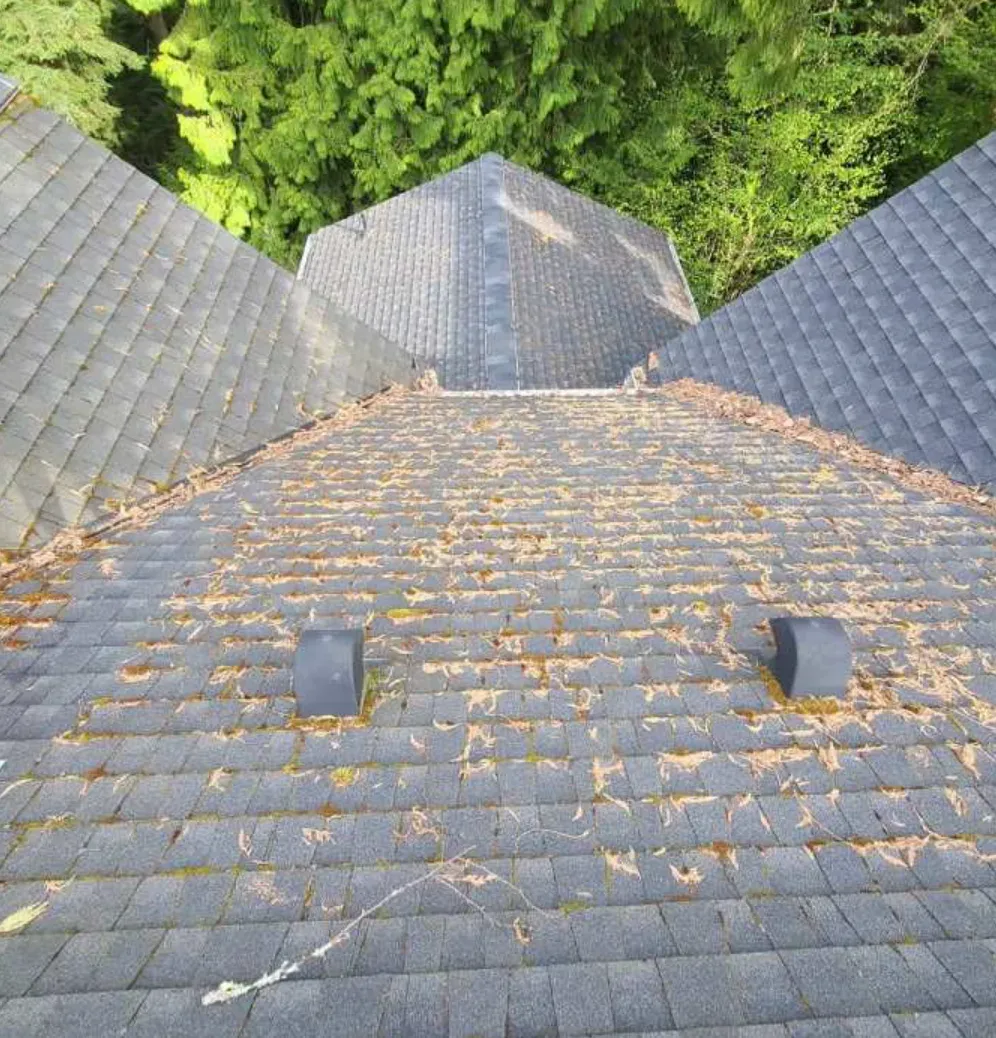
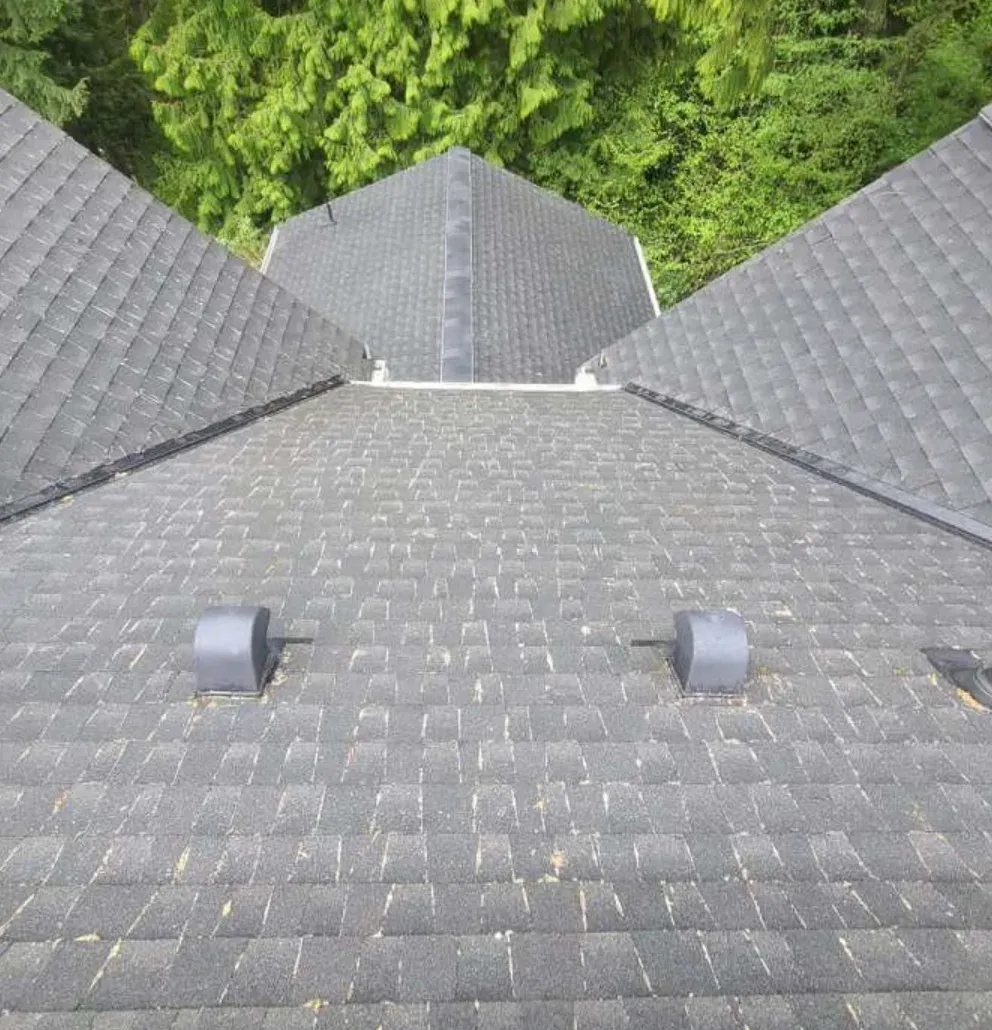
The same slope, before and after
Photographed from the same spot in the same light, before we started and again once we had finished.
Every roof in Saanich has a north side, and the north side is where this starts. Moss does not arrive because a roof is neglected. It arrives because a slope sits in shade, stays damp between October and March, and gives a spore somewhere to hold on. Under a mature Douglas fir or a Garry oak, that describes half the roofs on the street.
Left alone, moss stops being a cosmetic problem. A mat of it holds water against the covering long after the rest of the roof has dried out, and it spreads sideways — into the keyways of a cedar shake, under the butt edge of an asphalt course, along the pan of a concrete tile. As it thickens it lifts what it grows under. Water that gets under a course has somewhere to go that the roof was never designed to send it.
Taking it off is straightforward work done carefully. What decides the method is not the amount of growth. It is what the roof is made of.
Asphalt shingle: the granules are the roof
An asphalt shingle is a mat with a layer of mineral granules fused to the surface. Those granules are the wearing surface and the UV protection both. Lose them and the mat underneath starts ageing at a rate you can measure in years rather than decades.
That single fact rules out most of the quick methods. Pressure lifts granules. So does dragging a stiff blade across a course, and so does working uphill, which pushes both water and debris under the overlap. We work down the slope, lift the growth off rather than scraping through it, and accept that the last stain of it stays until the next few rainfalls take it.
Where growth has been sitting a long time you can usually see the outline of it after it comes off — a patch where the granules are visibly thinner than the shingle around it. That is worth knowing about. It tells you where this roof will fail first, and it is one of the things we point out rather than tidy past.
Cedar shake: soft where it matters
Cedar is the covering that most rewards patience and punishes speed. Growth sits in the keyways between shakes, where it stays wet longest, and a shake that has been damp for fifteen winters is softer than the same shake looked when it went on.
Hand work, then, and a lot of it. The aim is to clear the keyways and the butt line without lifting the shakes or breaking the weathered surface that is doing the shedding. A cedar roof cleared properly still looks like an old cedar roof afterwards — grey, textured, uneven. If it comes back looking new, something was taken off that should have stayed.
Concrete tile: heavy, and easy to walk badly
Tile takes growth along the pan and in the laps, and it can carry a surprising amount before anyone notices from the ground. The risk here is not the cleaning method, it is the walking. Concrete tile cracks under a foot in the wrong place, and a cracked tile does not announce itself — it leaks quietly into the underlay for a year.
So the work is planned around where the load goes, and the growth comes out of the laps rather than off the face alone. Growth in a lap is the part that holds water.
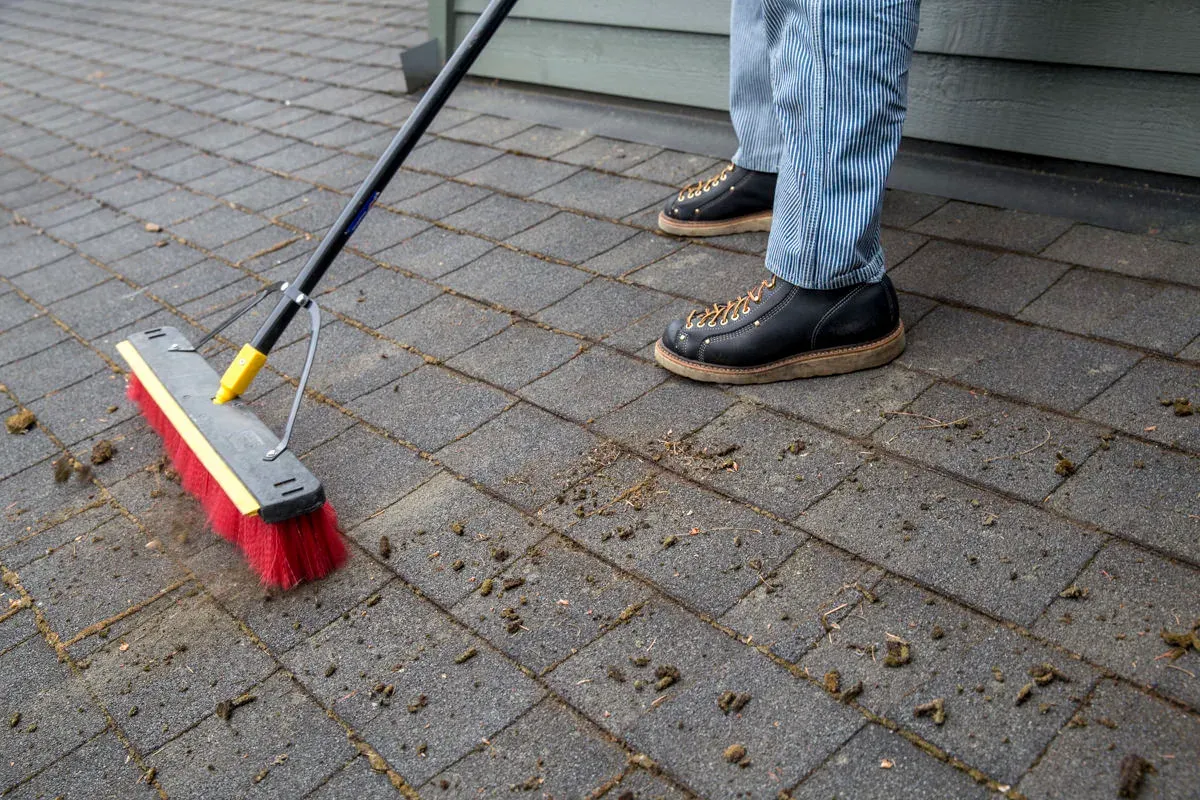
The parts nobody sees from the driveway
Valleys, hips and the lowest two or three courses are where this job is actually won or lost. A valley funnels water from two slopes into one channel; packed growth in a valley turns it into a dam. The lower courses sit above the gutter, stay wet longest, and are the last place anyone looks from the ground.
Those are the places we clear first, because they are the places where the consequences are structural rather than cosmetic. A roof cleaned beautifully on the faces and left packed in the valleys has had the wrong half of it done.
What you will hear afterwards
Standing on a roof shows you things a ladder at the eave never will. You get a plain account of it: which slopes had the worst of it, whether the growth had started to lift any courses, how the granules or the shakes or the tiles are wearing, and whether anything up there wants a roofer rather than us. If the answer is that the roof is fine and will want doing again in three years, that is what you will hear.
We work Monday to Friday, we are insured and WCB-registered, and the estimate is free with nothing attached to it.
Roofs are sorted by covering, not by postcode — start with cedar shake, asphalt shingle or concrete tile, or read what a full roof demossing covers.
How it works
How a Moss Visit Runs
Four steps, and the roof is ours from the moment the ladder goes up. You tell us what you are looking at, we price the roof in front of us, and you hear what we found before we leave.
Tell us what you can see
Your address, the roof covering if you know it, and which slopes have gone green.
A photo from the driveway is worth more than a description. North side, shaded by a big fir, growth thick enough to see from the road — that tells us most of what we need before we arrive.
We price the roof itself
Cedar, asphalt and concrete tile are three different jobs, and the quote reflects which one yours is.
Covering, pitch, height, how far the growth has spread and what stands under the eaves all move the figure. You have it before anything is booked.
The growth comes off carefully
Moss is lifted and brushed off the surface, not driven off with pressure.
We work down the slope so nothing is pushed under the courses, keep the run of water in mind the whole time, and take care around whatever is planted below.
You hear what the roof told us
Standing on a roof shows you things the lawn never will.
A course lifting at the edge, a valley holding damp long after the rest has dried, granules already thin where the growth was heaviest. You get that plainly, with nothing attached to it.
Four steps, and the green is gone.
- You send the address and a photo.
- We send back a price for your roof.
- The growth comes off.
- You know what shape the roof is in.
Send the form or call for a free, no-obligation estimate.
By property type
Roof Moss Removal by property type
Four property types, four different jobs. Pick the one that matches yours.
Cedar Shake
Cedar holds growth in the keyways and softens as it ages. This is slow hand work, and a cedar roof cleared properly still looks like an old cedar roof.
Read more →Asphalt Shingle
On an asphalt roof the granules are the wearing surface. Growth is lifted off by hand, worked down the slope, and never driven off with pressure.
Read more →Concrete Tile
Tile carries more growth than it looks like it does. The cleaning is straightforward; the care goes into where the weight lands, because tile cracks quietly.
Read more →Roof Demossing
Demossing, roof cleaning and moss removal are three names for one visit. This page sets out what that visit actually includes, and what it does not.
Read more →Customer reviews
What customers say
“The service provided by the owners of the company and the staff were beyond exceptional. The price was also very exceptable and affordable.”
“Amazing! Sent in a request form on their website in the morning, heard back that afternoon, and booked for the next day. Very fast, reliable, and efficient.”
Got questions?
Roof Moss Removal — questions
Will removing moss damage my roof?
Not when the method matches the covering. What damages a roof is moss left in place holding water against it, or growth taken off with pressure that lifts granules and drives water under the courses. We work by hand, down the slope, and adjust the method to what the roof is made of.
Why not just pressure wash the roof?
Because an asphalt shingle is a mat coated in granules, and pressure strips them. The roof looks better for a season and then ages faster than it should. Pressure also drives water uphill under the courses, which is the one direction a shingle roof is not built to handle. We do not pressure wash roofs.
How long until the moss comes back?
On a shaded north slope under trees, growth usually starts to show again within a couple of seasons. On an open, sunny roof it takes longer. Treatment slows regrowth down; nothing stops it outright, and anyone telling you otherwise is selling you something we would not.
What time of year is best for moss removal?
Late spring through early autumn, once the growth has dried out and before the wet season starts again in October. Dry moss lifts cleanly. Wet moss tears and leaves the root mat behind, which means more of it stays on the roof.
Do you work on cedar shake?
Yes, and it is the covering that most rewards care. Cedar holds growth in the keyways between shakes, and the shakes themselves are softer than they look once they have been wet for a decade. It is hand work, and it takes longer than an asphalt roof of the same size.
Can you tell me how much life my roof has left?
We can tell you what we saw and what it usually means — thinning granules, curled edges, a valley that stays damp, shakes going soft at the butts. That is an honest read from someone standing on it, not a roofing inspection, and we will say which one you need.
Do I need to be home?
No. We need access to the roof and somewhere to set a ladder. If you would rather not be there, tell us where to park and how to get round the back, and we will send you what we found afterwards.
Are you insured?
Yes. We are insured and WCB-registered, which matters more on a roof than almost anywhere else we work. You are covered while we are up there.
What happens to the moss you take off?
It comes off the roof, out of the gutters, and away with us. Growth raked off a slope and left in the gutter or in a garden bed is half a job — it ends up back in the drainage or back on the roof.
Is moss actually a problem, or is it just how it looks?
Both, but the appearance is the smaller half. Moss holds moisture against the covering long after the rest of the roof has dried, and it grows sideways under the courses, lifting them slightly as it thickens. Water that gets under a course has somewhere to go that it should not.
Roof Moss Removal in Victoria and the surrounding area
Tell us the address and we will get you a price.